

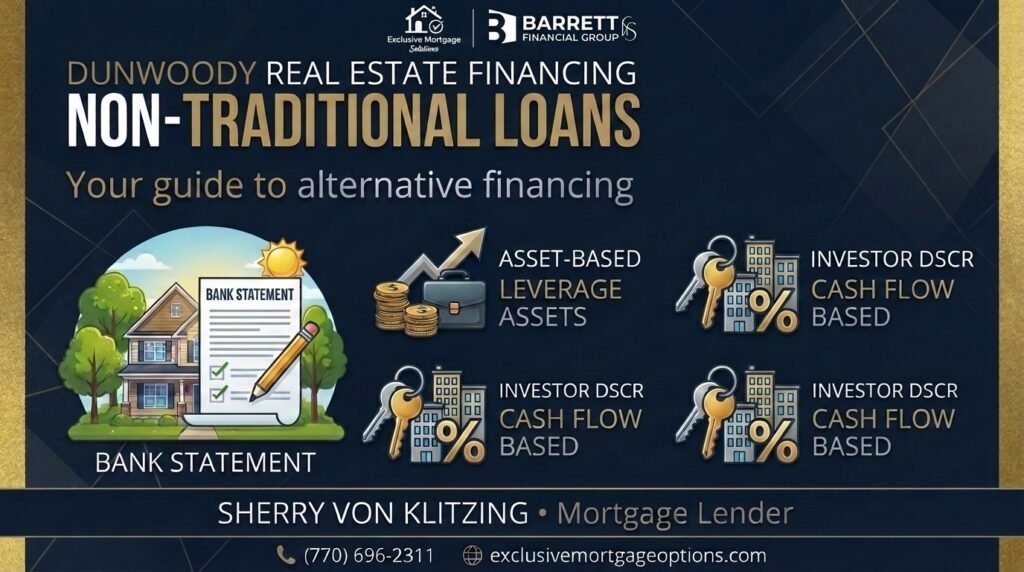
Dunwoody Real Estate Market Guide for Buyers Using Non-Traditional Loans
Dunwoody sits next to Perimeter Center, with two MARTA stations and quick access to I-285, GA-400, and I-85. That mix draws a lot of buyers whose income doesn’t fit a standard W-2 file: business owners, consultants, 1099 earners, investors, and professionals relocating from abroad. If that’s you, Dunwoody real estate financing works a little differently, and knowing the options before you tour homes can save you time and stress.
This guide covers where the Dunwoody market stands right now, which non-traditional loan programs fit which buyers, and how to build a financing plan before you make an offer. It comes from the team at Exclusive Mortgage Options, led by Sherry von Klitzing, a mortgage broker serving Dunwoody buyers for over 20 years.
What the Dunwoody Market Looks Like Right Now
Dunwoody is a DeKalb County city, and its home values run well above the county as a whole. Public trackers don’t agree on one number, because each uses a different method and time window, but they point to the same range. Typical Dunwoody home values and median sale prices are landing roughly between $650,000 and $710,000, with prices up modestly year over year. Homes have been going under contract in about two to four weeks, and a meaningful share of sales close at or above list price.
Rates matter as much as prices here. Freddie Mac’s weekly survey put the 30-year fixed rate at 7.40% in mid-October 2026. On a loan in the $500,000 range, that makes loan structure a real part of your strategy, and it is a good reason to compare programs before you commit.
Why Some Dunwoody Buyers Don’t Fit a Conventional Loan
Conventional underwriting is built around W-2 income, two years of tax returns, and a tidy debt-to-income ratio. These buyers often run into trouble:
- Business owners whose tax deductions shrink their reported income
- 1099 contractors and consultants with income that varies month to month
- Real estate investors who want to qualify on a rental’s income instead of their own
- Foreign nationals and ITIN borrowers without a U.S. credit history or Social Security number
- Retirees and high-net-worth buyers with large assets but little monthly “income”
Getting turned down by one lender doesn’t mean you can’t be financed. As Sherry explained in her Gwinnett Business Radio interview, a denial often means your file didn’t fit that one lender’s guidelines.
Non-Traditional Loan Options for Dunwoody Buyers
Bank Statement Loans for Self-Employed Buyers
A bank statement loan qualifies you using 12 to 24 months of personal or business bank statements instead of tax returns. Lenders review your deposits and apply an expense factor to estimate qualifying income.
Illustrative example, not a quote: A business owner deposits $216,000 into a business account over 12 months. If a lender applies a 50% expense factor, qualifying income is about $108,000 a year, or $9,000 a month. A lender may use a different factor depending on the business, which is why guidelines are worth comparing.
DSCR Loans for Dunwoody Investors
With a DSCR loan, the property’s rental income has to cover its own payment, including principal, interest, taxes, insurance, and any HOA dues. Your personal income isn’t the test. Our full guide to DSCR loans in Georgia covers documents and down payments.
Illustrative example, not a quote: On a $380,000 Dunwoody townhome with 25% down at 7.5%, the loan is about $285,000 and principal and interest run roughly $1,990 a month. Add an estimated $550 for taxes, insurance, and HOA, and the payment is about $2,540. If the home rents for $2,700, the ratio is about 1.06. On higher-priced homes, rent may not cover the payment at current rates, so some programs allow ratios below 1.0 with a larger down payment or a higher rate.
Jumbo Loans for Higher-Priced Homes
Many Dunwoody homes sit near or above conforming limits, especially in ZIP 30338 neighborhoods with larger lots. Our guide to jumbo loans in Atlanta explains the credit, reserve, and down payment standards. We arrange jumbo financing up to $3.5 million.
Asset-Based Qualification
If you have substantial savings or retirement assets but little regular income, some programs count your assets as income. Sherry described a method that spreads qualifying assets over roughly five years to calculate monthly income. The exact formula varies by lender.
Foreign National and ITIN Loans
Dunwoody draws international professionals thanks to Perimeter Center’s corporate offices. If you don’t have a Social Security number or U.S. credit history, read our ITIN mortgage guide. These loans usually require a larger down payment and extra documentation.
Comparing Your Options
| Your Situation | Program Worth Comparing | Main Documentation |
|---|---|---|
| Business owner, high deductions | Bank statement loan | 12 to 24 months of statements |
| Investor buying a rental | DSCR loan | Lease or rent estimate, reserves |
| Buying above conforming limits | Jumbo loan | Full documentation, larger reserves |
| Asset-rich, low monthly income | Asset-based program | Asset statements |
| No SSN or U.S. credit history | ITIN or foreign national loan | ITIN, alternative credit, larger down payment |
| Buying before selling your home | Bridge loan | Equity in current home |
Buying Before You Sell: Bridge Loans
Many move-up buyers face the timing problem of needing to buy in a fast market before their current home sells. A bridge loan can use your current equity to fund the new purchase, so you can make a stronger offer without a sale contingency.
Steps to Take Before You Start Touring
- Get pre-approved on the right program, not just a generic estimate. A bank statement or DSCR approval is a different file from a conventional one.
- Gather your documents early. Self-employed buyers should line up 12 to 24 months of statements. Investors should collect rent estimates and entity documents.
- Plan for closing costs. The Consumer Financial Protection Bureau explains how to read your Loan Estimate.
- Compare more than the rate. Down payment, reserves, and prepayment terms matter as much as the rate on non-traditional loans.
- Talk to your agent about financing. Our real estate services team coordinates both sides of the purchase.
Already Own in Dunwoody? Consider Refinancing
If you already own a home in the area, equity may be your best tool. See our guide on refinancing in Sandy Springs, which applies equally to Dunwoody homeowners, for break-even math and cash-out versus HELOC comparisons.
Frequently Asked Questions
Can I buy a home in Dunwoody if I’m self-employed?
Yes, many self-employed buyers qualify through bank statement programs that use deposits instead of tax returns. Approval depends on your credit, down payment, reserves, and the lender’s guidelines.
What credit score do I need for a non-traditional loan?
It varies by program. Many bank statement and DSCR programs look for scores in the 600s to 700s, with better pricing at higher scores.
Do non-traditional loans cost more than conventional loans?
Rates are often somewhat higher, reflecting the flexible documentation. The trade-off is access to financing a conventional lender might not offer.
Can I use a DSCR loan to buy a Dunwoody condo or townhome?
Often yes, though condo projects have their own lender requirements, including HOA reserves and owner-occupancy ratios. Check eligibility before you write an offer.
How much down payment will I need?
Bank statement loans commonly start around 10% to 20% down, and DSCR and ITIN programs often want 20% to 25%. Exact requirements depend on the lender.
Can you work with my real estate agent?
Yes. We coordinate with your agent on timelines, so your financing supports your offer instead of slowing it down.
Start Your Dunwoody Financing Plan
The right loan depends on how you earn, what you’re buying, and how long you’ll hold the property. Visit our Dunwoody mortgage broker page or browse our full mortgage services and non-traditional mortgage programs.
We also work with buyers in nearby Sandy Springs, Roswell, and Alpharetta. First-time buyers can start with our Roswell first-time buyer guide, and anyone weighing financing in the northern suburbs can read about Alpharetta home financing. We serve clients across Georgia, Alabama, Florida, North Carolina, and California, and you can find more guides on our mortgage resources blog.
Schedule a free consultation or call (470) 588-4400 to talk through your options with Sherry von Klitzing (NMLS #1004049).
Examples are illustrative and not a rate quote or commitment to lend. Rates, programs, and approval depend on your credit, income, assets, property, and lender guidelines.