

Property valuations are a significant component of the overall real estate transaction process. Sellers need to know the property price, while buyers use the rental property’s value in order to ascertain whether they are making a good real estate investment.
By identifying whether the purchase price matches the fair market value of the rental property, property valuation assures a rental property mortgage lender that they are not overfinancing the land. It’s also used for tax purposes, letting the county identify the appropriate property taxes to impose.
Those seeking to transfer property to a relative also need to know the worth of their real estate. If the property is inherited, the new owner may need to pay an estate tax. They may also need to know the property value in order to list it among their assets.
Lastly, in the case of compulsory acquisition, the government is legally obligated to provide just compensation to the previous owner, and this can only be determined by assessing the property value.
How to Evaluate Rental Property Value
There are five primary ways that you can calculate property value, each of which has its uses. An appraiser typically uses a combination of three methods: the sales comparison approach, the income approach, and the cost approach. However, you should analyze each of these when running your own calculations to value a rental property.
1. The Sales Comparison Approach
The sales comparison method is one of the most common valuation methods for single-family rental properties and land. With this method, you calculate property value based on similar properties that were recently sold in your market.
You need to have at least three comparable properties to properly assess value. They should be as similar as possible, including in size, age, and location.
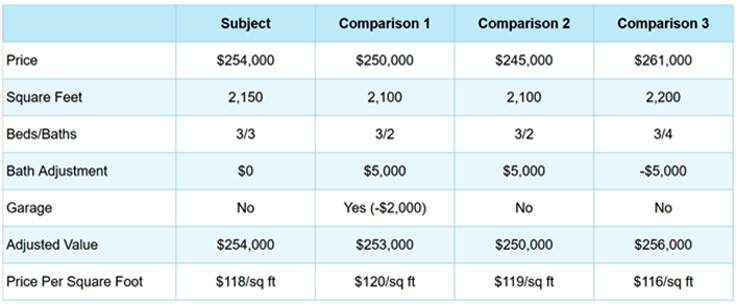
You’ll include factors such as square footage, number of bedrooms and bathrooms, and absence or presence of garage, then adjust the value by adding or subtracting value. When you’ve completed this analysis, you’ll determine a price per square foot that identifies the true property value.
An example comparison for rental property may look like this:
2. The Capital Asset Pricing Model
The capital asset pricing model is used for a variety of different investment options. It’s most often used to assess a commercial real estate portfolio, such as Real Estate Investment Trusts (REITs), rather than a singular rental property.
It helps real estate investors identify the return on investment by comparing how much their investment properties would return in comparison to a risk-free investment like government bonds.
For example, their return on investment, when assessed with this model, might be 9% in comparison to the 3% on a government bond. This will allow them to decide whether the potential rental income is worth the possible losses associated with market volatility.
3. The Income Approach
Also known as the income capitalization approach, this is the most commonly used method for determining the value of a rental property such as an apartment complex, office building, or strip mall.
It depends on the relationship between the rate of return and the property’s net operating income, adjusted by the capitalization rate or cap rate, in order to analyze whether the real estate investor would be making the profit necessary to satisfy their needs.
How to Calculate Using the Income Approach
The formula for the income approach is simple: the property value equals the net operating income divided by the capitalization rate, also known as the cap rate.
To calculate property value using the income approach, assume a property has an expected rental income of $20,000, with operating expenses of $7,000.
After subtracting operating expenses from the income, you have a Net Operating Income (NOI) of $13,000. This adjusted rental income needs to be divided by the capitalization rate.
The cap rate is 5%; divide the NOI by 0.05, and you arrive at an estimated property value of $260,000.
4. Gross Rent Multiplier Approach
Like the income approach, the Gross Rent Multiplier approach determines the property value based on rental income. It’s typically used for residential investment property, including single family homes and multifamily real estate.
However, unlike the income approach, this method does not consider the property’s operating expenses, like property taxes, property management fees, or the mortgage payment, and so it is a rougher estimate. It also values the rental property based on the annual income and purchase price of a comparable property, similar to the sales comparison approach.
How to Calculate Using the Gross Rent Multiplier
To value a rental property using this method, you divide a rental property value by a gross annual rental income from a similar property to create a gross rent multiplier, which is then applied to the gross annual rental income of the property you would like to purchase.
The adjusted gross rental income is the property’s rental income from all units plus any additional income, such as that from parking spaces, pet rent, and on-site services like laundry.
As an example, assume that a recently sold property had a purchase price of $400,000, and its gross rental yield is $40,000. Divide the property price by the property’s gross rental income to get a multiplier of 10.
Your target property has a gross rental income of $30,000. Multiply this by the gross rent multiplier to get a property value of $300,000.
This method is helpful for real estate investing because when you value a rental property this way, you can identify lost rental income. In the above example, you can see that the higher-income property raised its value by $100,000 simply by netting $10,000 more gross rental income.
However, it’s important to remember that it does not take into account operating expenses, so a rental property appraised by this method may not hold true to what is identified by more standard valuation methods.
5. The Cost Approach
As a valuation method used by appraisers, the cost approach allows real estate investors to calculate property value based on how much it would cost to replace it with an entirely new structure.
It considers factors like age, location, and obsolescence. The cost approach is best used for relatively new real estate, as it can be too difficult to estimate the market value of an older property with this method.
How to Calculate Using the Cost Approach
When you value a rental property using the cost approach, you identify the rental property value by identifying the replacement cost minus three factors: physical depreciation, functional obsolescence, and external obsolescence.
Property Value = Replacement Cost – (Physical Depreciation + Functional Obsolescence + External Obsolescence)
Let’s assume that, after research, you identify that the market value for a nearly identical piece of real estate would be $200,000.
Physical depreciation refers to age-related wear and tear on the property. Assume that this cost comes out to $20,000.
Functional obsolescence is the cost of modernizing the rental property, such as changing the layou. For this example, we can assume that the property has $15,000 in functional obsolescence to fix.
Last is the external obsolescence, which refers to changing environmental or economic conditions around the rental property. If a factory moved in down the street and lowered property values, this may result in $10,000 of external obsolescence.
Subtracting the combined $45,000 for these three factors, one arrives at a total property value of $155,000.
Who Conducts Property Valuation?
Property value is assessed by appraisers, also known as property valuers or land valuers. Every jurisdiction has different regulations around who can appraise property. You can ask your real estate agent for recommendations on a qualifier appraiser in your area.
Key Takeaways on Property Valuation for a Rental Property
Determining property value is a significant aspect of choosing a rental property for real estate investing, as it helps you identify promising opportunities. It’s best to use multiple property valuation approaches. This will give you a more comprehensive overview and prevent you from making hasty decisions.
You should work with trusted professionals who have a reputation for fair valuations and seek a second opinion if you’re unsure. Real estate agents are often excellent resources for those seeking to net a high-income rental property.
Remain on the lookout for opportunities to enhance your rental income, such as through upgrades and improved amenities, in order to keep your property value high.
The Factors That Influence the Rental Value of Your Property
When it comes to real estate investing, understanding what drives the rental value of a property is crucial to maximizing your returns. Several key factors can influence how much rent you can charge, whether you’re dealing with residential or commercial properties.
Key Factors That Influence Rental Value
- 1. Local Market: The overall market in your area plays a significant role in determining rental prices. In smaller or less competitive markets, properties tend to be more affordable, which can affect rental rates. In contrast, properties in larger, more competitive markets can command higher rents.
- 2. Location: The location of your property is a major determinant of its rental value. For commercial real estate, properties on busy streets or in high-traffic areas tend to be more profitable. On the other hand, residential tenants often prefer quieter neighborhoods, which can impact rental demand and pricing.
- 3. Number of Bedrooms: In residential real estate, the number of bedrooms in a property can significantly impact its income potential. More bedrooms typically mean the ability to charge higher rents, as larger properties can accommodate more tenants or families.
- 4. Furniture: Including high-quality furniture in your rental property, especially in commercial real estate, can make the property more attractive to potential tenants. Furnished properties often justify higher rents and attract tenants who are willing to pay a premium for convenience.
- 5. Amenities: Amenities such as on-site laundry facilities, parking, and modern appliances can significantly increase the rental value of residential properties. Tenants are often willing to pay more for these added conveniences.
- 6. Property Condition: The condition of your property is another critical factor. Newer properties or those that have been well-maintained require less upkeep and are generally more attractive to potential tenants, which can translate into higher rental income.
Can You Increase the Rental Value of Your Property?
The good news is that as a real estate investor, there are several strategies you can employ to increase the rental value of your property, ultimately boosting your gross cash flow and ensuring a steady income.
Ways to Increase Rental Value
- Upgrade Kitchens and Bathrooms: Modernizing key areas like the kitchen and bathrooms can significantly enhance the appeal of your property and justify higher rent.
- Update the Layout: Making changes to the property layout to improve functionality or flow can make it more attractive to potential tenants.
- Build an Addition: Adding an extra bedroom or expanding living spaces can increase the rental income potential, especially in residential properties.
- Include On-Site Parking: Providing on-site parking is a valuable amenity that can attract tenants willing to pay more for the convenience.
- Enhance Landscaping: Improving the land value through landscaping not only boosts curb appeal but can also increase the overall rental value of your property
By focusing on these factors and making strategic improvements, you can effectively increase the rental value of your property and maximize your returns on investment.